When I first began practicing Reiki, it was my private sanctuary. I used it for myself alone, an intimate practice to restore balance when life felt heavy.
But as my practice deepened, and I began offering Reiki to others, I noticed a shift. My instinct was to send Reiki outward, to clients, loved ones, even the collective. I became a vessel, holding, channeling, and sending.

While this brought moments of beauty, it also raised a question: how much can we really hold?
We are often told that Reiki is limitless, that the flow of energy never runs out. And it is true. Yet the vessel, the practitioner, is human.
What drains us is not Reiki itself, but the habit of always giving outward before tending inward. The energy does not exhaust; it is forgetting where the flow begins.
The Profile of Reiki Practitioners
Many Reiki practitioners share certain qualities: empathy, intuition, compassion, and a natural drive to help. We are often drawn to the healing arts because we feel deeply and want to ease suffering wherever we encounter it.
This makes us pillars in our communities, holding space in times of need. Yet it also makes us vulnerable to overgiving. We give our energy outward freely, sometimes to the point of depletion. Sometimes, unconsciously, we act as if the measure of our devotion is endless giving, when in reality, our strength lies in balance.
Being a pillar is not the same as carrying the world. A true pillar is steady because it is nourished, grounded, and aligned, not because it sacrifices itself endlessly. Recognizing this is the first step toward sustainable healing practice.
Easier said than done, I know, but with awareness, we can move away from overgiving to balance.

Beyond Symbols and Technique
We learn how to channel energy, focus intention, and offer the practice with love. But symbols and hand positions, the technique alone are not the heart of Reiki. The true discipline lies not just in how we channel, it is in where we begin.
Do we start with everyone else first? Or do we begin with ourselves, filling until we overflow? This distinction is subtle, and yet we forget. A practitioner who gives only outward risks becoming a dry riverbed. A practitioner who begins with self becomes like a spring, constantly replenished, overflowing without effort.
The Empty Cup Paradox
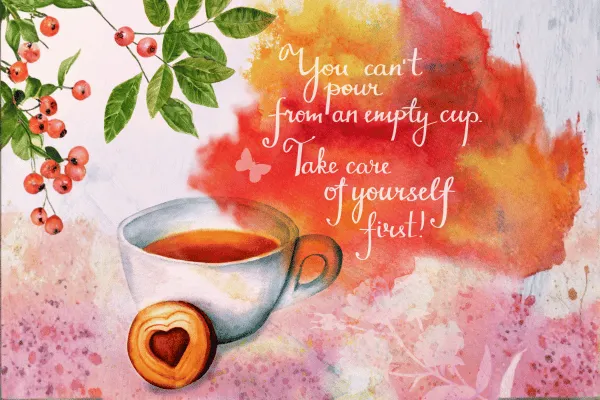
You cannot pour from an empty cup. For Reiki practitioners, this often feels paradoxical. After all, Reiki is infinite energy, flowing from the Source, and yet the human vessel that channels it has limits. The exhaustion we feel does not come from the energy itself, it comes from the imbalance between giving outward and tending inward.
Many healers fall into a pattern of overgiving. We send Reiki to clients, loved ones, and even strangers, sometimes before we have checked in with our own energy. In this way, our cups slowly drain without us even realizing.
The paradox deepens when we consider that self-care is often seen as secondary or even selfish by both ourselves and the culture around us. We may get trapped in the worry of pausing, resting, or prioritizing our own healing might make us “less of a healer.” Yet the truth is the opposite: a filled cup radiates stronger energy, clearer intention, and a more grounded presence.
Even in other practices, the same principle shows up. In Vishen Lakhiani’s 6 Phase Meditation, the sequence begins with blessing oneself before extending blessings outward. If we cannot root compassion within, how can we sincerely radiate it outward?
Reiki, like life, follows the same law: self-nourishment first, then overflow.
Practically, this means acknowledging that we are not just conduits of universal energy, but living beings with cycles, limits, and needs. Ignoring these needs can manifest as physical fatigue, emotional depletion, or subtle detachment from the Source.
On the other hand, when we care for ourselves, through self-Reiki, rest, and conscious boundary-setting, our energy flows freely and fully.
The Empty Cup Paradox is not a warning, it is an invitation. It asks us to examine how we show up in our practice. Are we constantly pouring outward from a shallow well? Or are we committed to first filling ourselves, so that the energy we offer is abundant, steady, and nourishing for both ourselves and others?
The Discipline of Self-Reiki
To be a pillar of Reiki is not to hold up the world at our own expense. It is to be steady because we are nourished. This requires discipline, not in merely relying on the symbols and techniques alone, but in committing to self-Reiki too, as the foundation of everything we do.
Here are some practices that have kept me balanced:
- Self before service: Begin each session offering Reiki inward until one feels full and centered.
- Overflow, not sacrifice: Allow Reiki to spill outward naturally, rather than forcing it.
- Cycles of integration: Make space for rest and silence, so one remains clear as a channel.
- Boundaries as containers: View boundaries not as walls, but as sacred structures that keep the flow balanced.
Redefining the Pillar
Too often, healers equate being a “pillar” with endless availability and unbroken strength. But a true pillar of Reiki does not deplete itself, it embodies balance, grounding, and overflow.
When we care for ourselves first, the Reiki we offer carries a different quality. The energy is not tinged with fatigue or silent resentment rather, we channel energy that is radiant, authentic, and sustainable.
Clients sense this balance. They feel not just the energy we offer, but the authenticity of how we live the practice. In caring for ourselves, we show that self-healing is never selfish but essential.
A Reflection for Practitioners
What would it mean to truly embody overflow? To let Reiki fill us so deeply that giving becomes effortless expression?
Perhaps the deeper invitation of Reiki is more than how we serve others, but in how we allow ourselves to receive. Reiki is infinite, and we are human. In that meeting point lies the beauty of the practice.
“True Reiki begins with self-care, and only then can it overflow to others.”
To be a pillar of Reiki is not to carry everyone else’s weight but to stand rooted in our own alignment, so the energy flowing through us blesses the world without ever draining.
Article by PJ Valenciano
Free eBook download: We’ve created an eBook with our best articles on this topic, and offer it for free to all our newsletter subscribers.

PJ Valenciano—She/Her
Living as a digital nomad in the countryside, surrounded by nature, has allowed PJ to truly appreciate the beauty and simplicity of life.
While she primarily works as a digital marketing professional from the Philippines, she is also a Mental Health Advocate and a Reiki Master.
PJ is passionate about weaving creativity, purpose, and growth into every project. She has collaborated with diverse organizations and individuals across industries, crafting authentic stories and advocating for a community that emanates kindness, compassion, and support for all life forms.
She finds joy in fostering genuine connections and believes that each interaction is an opportunity to learn from one another and create meaningful impact. While her unconventional background may not fit traditional job descriptions, she is intentionally living a life aligned with her soul’s purpose.
Contact: www.fairsimplelife.com



Leave a Reply